Why the Moon Changes Shape Through the Month
Why the Moon changes shape through the month comes down to sunlight and viewing angle; learn to read its phases without mistaking them for shadow.
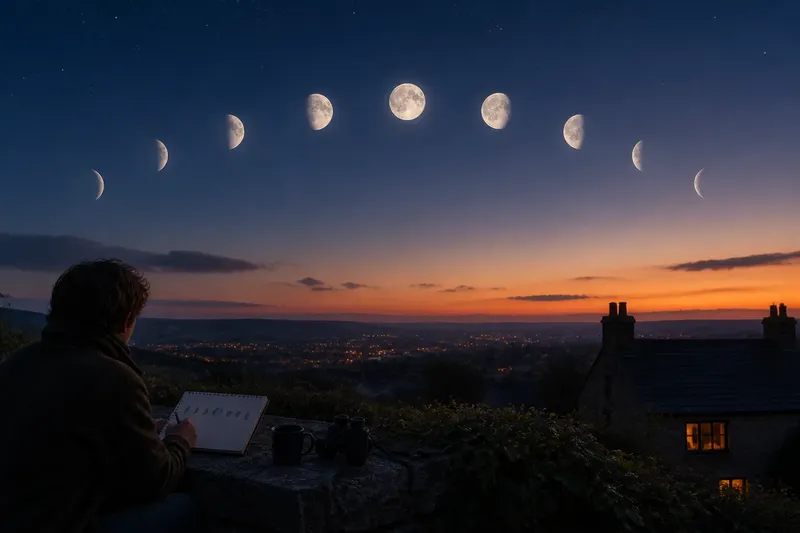
The Moon changes shape through the month because sunlight reaches half of it while our view of that lit half changes. On a clear evening, the crescent is not a sliver of Moon emerging from darkness: it is a round body seen at an angle, with much of its sunlit side turned away from Earth.
The Sun always lights half the Moon
Sunlight illuminates one hemisphere of the Moon at any moment, just as it lights one side of Earth. The boundary between the lit and unlit portions is real, but it is not the curved edge that defines the Moon’s phase. From Earth, we see a changing fraction of the illuminated hemisphere as the Moon travels around us.
That distinction matters because the dark part of a crescent is not usually Earth’s shadow. It is the lunar night side: ground that is turned away from the Sun. The Moon’s surface remains a sphere; only the visible outline of its daylight changes.
The angle between the three bodies sets the phase
The Sun, Earth and Moon form a changing arrangement. At new Moon, the Moon lies broadly in the direction of the Sun, so its sunlit face points away from us and the Moon is difficult to see. As it moves along its orbit, more of the lit hemisphere comes into view.
At full Moon, Earth is broadly between the Sun and Moon, and the side facing us is illuminated. The sequence between those positions produces the familiar waxing and waning phases. “Waxing” means the visible lit portion is growing; “waning” means it is shrinking. The Moon itself is not swelling or thinning. It is behaving rather like a ball under a lamp as you walk around it.
The alignment is not usually exact. The Moon’s orbit is tilted relative to Earth’s path around the Sun, so the Moon generally passes above or below Earth’s shadow at full Moon. That is why an eclipse is an occasional alignment, not the normal cause of the monthly phases.
The phases are easiest to read as a sequence
- New Moon: The sunlit side faces mostly away from Earth. The Moon may be lost in the Sun’s glare.
- Waxing crescent: A narrow lit arc appears after new Moon, growing from night to night.
- First quarter: About half of the Moon’s visible disc is lit, and the Moon is roughly a quarter of the way through its orbit. “Quarter” refers to the orbit, not the amount of visible illumination.
- Waxing gibbous: More than half the visible disc is lit, with the lit area continuing to grow.
- Full Moon: The near side appears fully lit.
- Waning gibbous: The lit portion begins to shrink after full Moon.
- Last quarter: About half the visible disc is lit again, on the opposite side from first quarter.
- Waning crescent: A narrowing arc remains before the next new Moon.
The exact appearance depends on where you are and when you look. In the Northern Hemisphere, the waxing crescent is commonly lit on the right and the waning crescent on the left; in the Southern Hemisphere, the orientation is reversed. Near the equator, the crescent can appear more like a shallow bowl. Those are changes in viewing orientation, not different phases.
Moon phases become clearer when you compare evenings
A single glance can make the phase seem ambiguous, especially when the Moon is low or thin. Keep a simple observing note: write the date, time, phase you think you see, and which side appears illuminated. A quick sketch is often more useful than a polished description. Return to roughly the same place on another evening and compare the lit edge.
Say you notice a slim crescent above a roof after sunset and sketch the bright arc. On a later evening, you look from the same garden and see a broader lit section, shifted against the rooftops. The expected observation is a growing visible portion and a changed position in the sky, not a shadow creeping off the Moon.
The Moon also rises later on successive days, so it will not always be waiting in the same part of the evening sky. Its phase and its time of visibility are related to its position in orbit, but they are not the same observation. A phase note records how much of the near side is lit; a sky note records where and when you found it.
Why does Earth’s shadow not make the ordinary phases?
Earth’s shadow falls on the Moon during a lunar eclipse, when Sun, Earth and Moon line up closely enough for the Moon to pass through that shadow. Most full Moons miss it because the Moon’s orbit is tilted. The ordinary phases instead arise from the changing angle between the Sun, Earth and Moon.
Why is a crescent visible near sunset?
A waxing crescent is near the Sun in the sky, so it is often seen shortly after sunset, though its visibility depends on its position and local conditions. The bright arc is sunlight reflected from the lunar surface; the unlit area is not being hidden by Earth.
Why is the Moon sometimes visible in daylight?
The Moon is above the horizon during daylight for part of its orbit, and its sunlit surface can stand out against the blue sky. Its visibility depends on the phase and its position relative to the Sun, so some daytime Moons are easier to notice than others.
Why does the Moon’s orientation seem to change?
Your viewing direction changes as the Moon moves across the sky, and observers in different hemispheres see it from different orientations. The pattern of phases remains the same, while the apparent tilt or side of the bright portion can differ.
Use the lit edge to identify what is changing
When the Moon looks like a curved fragment, trace the boundary between light and dark in your mind. That boundary, called the terminator, separates lunar day from lunar night. Its curve follows the shape of the spherical Moon, while the changing amount of visible light tells you where the Moon is in its phase cycle.
That is the useful distinction behind why the Moon changes shape through the month: sunlight illuminates half, and our orbital viewpoint reveals different fractions of that half. Once you separate illumination from shadow, a crescent becomes a readable view of the Sun–Earth–Moon arrangement rather than a puzzle about what has covered the Moon.