A Clear Autumn Evening for Learning the Constellations
Learn constellations on a clear autumn evening by tracing a few recognisable star patterns and recording how they relate, without equipment or memorisation.
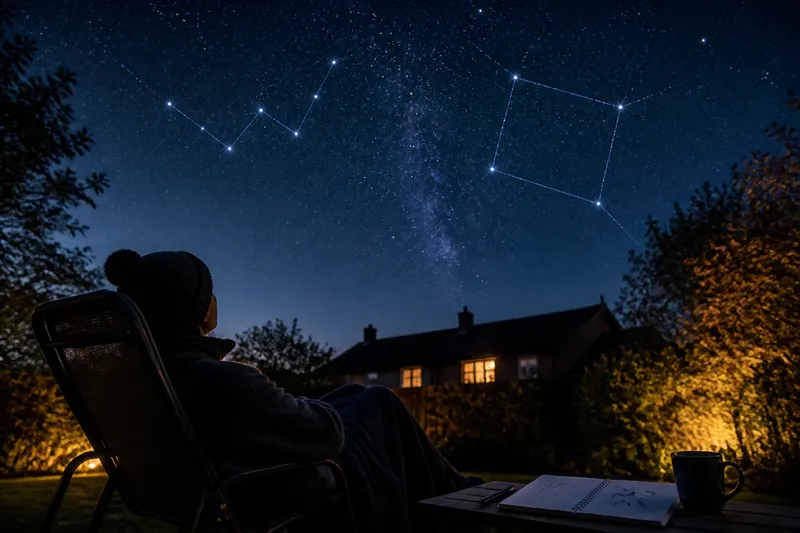
Learning constellations on a clear autumn evening starts with recognising a shape, not reciting its name. From a familiar place with an open view, a few bright patterns can give you useful landmarks for finding your way around the sky.
Autumn darkness arrives early enough for an evening session, but the sky changes with the time and your location. Before heading out, check that clouds have left at least part of the sky open and choose a spot where you can look up without straining.
Choose a familiar place with a clear view
A garden chair, a park bench or a quiet patch near home can all work. Look for an open section of sky between roofs and trees, and choose a place you can reach safely in the dark. If branches hide the horizon, start higher up rather than making a low-lying pattern your first target.
Back support helps if you are watching overhead for a while. A reclining chair or a dry blanket on level, familiar ground can also make looking up more comfortable. Bring a warm layer and take a break if the cold or a stiff neck starts to distract you.
Check the weather and the view before settling in. If cloud covers the area you hoped to observe, look for a clear opening or leave the session for another evening; a forecast is not a contract.
Use star patterns to learn constellations on a clear autumn evening
Begin with the brightest points in one section of sky and describe their arrangement in ordinary words: a square, a bent line or a zigzag. Hold off on names until the outline is clear. A constellation is easier to remember when you recognise its shape and its place among neighbouring patterns.
When visible from your location and at your chosen time, the Great Square of Pegasus offers four prominent stars in a broad, roughly square outline. It may look tilted rather than like a box drawn neatly on a page. Cassiopeia’s bright stars form a zigzag often compared to a W or an M; its apparent tilt changes as it moves across the sky.
Imagine you are in a garden where trees block the low horizon. You spot Cassiopeia’s zigzag high above the roof, then notice the Great Square of Pegasus farther across the open sky. You have two shapes to recognise and compare, even though the view gives you no useful horizon landmarks.
Connect one clear outline to the next
Once a bright pattern is familiar, look around it for another conspicuous group of stars. Perseus and Andromeda are autumn constellations that may be visible from many northern locations, though visibility depends on the time, location and local obstructions. If the field looks crowded, return to the first outline and search from there rather than scanning at random.
Count only the stars that make the clearest edges at first. Extra points may help complete a pattern later, but they can also make its outline harder to pick out. It is rather like recognising a key by its shape before noticing the scratches on it.
Not every bright point belongs to the constellation you are tracing. A planet may stand out among the stars, while the star patterns retain their shapes relative to one another. Leave uncertain objects unidentified; the first aim is to learn the outlines.
Keep a short record of what you recognised
Before going indoors, write down the pattern and one nearby landmark, such as a second constellation or the edge of a roof. “Zigzag above the roof, square farther left” is enough to prompt your memory, though the directions make sense only from that particular spot.
On another clear evening, return to the same place and see which shapes you recognise without searching from scratch. The sky will have shifted, so use the patterns’ relationships rather than expecting them to sit in precisely the same place.
Which constellation questions come up on a first evening?
Which constellations are easiest to recognise in autumn?
Start with a prominent outline such as the Great Square of Pegasus or Cassiopeia’s zigzag when it is above your horizon. Which one is visible depends on your location and the time of observation.
Do I need a map or an app to begin?
No; you can start by noticing bright shapes and how they relate to one another. A map or astronomy app can help identify a pattern afterwards, but the screen is optional.
Why can I see fewer stars than I expected?
Cloud, haze, the Moon, nearby lights and the height of buildings or trees can all obscure fainter stars. If the view is poor, concentrate on the clearest bright pattern or try again on another clear evening.
How can I remember a constellation after I go indoors?
Describe its shape and record what lay beside it from your observing spot. Those relationships are often easier to recall than a list of star names.
Use these observations to choose what to do next
- Check the sky for cloud: if a clear opening includes a bright pattern, start there; if cloud covers the whole view, postpone the session.
- Check for an open patch above the horizon: if trees or roofs leave a useful section of sky, work within it; if they block your chosen pattern, switch to a clearer direction.
- Check whether you can recognise a simple outline: if its main stars are distinct, trace a neighbouring pattern; if they blur together, return to the brightest points and describe their shape.
- Check whether your first pattern is visible at your location and time: if the Great Square of Pegasus or Cassiopeia is in view, use it as an anchor; if neither is visible, choose another bright arrangement rather than forcing the search.
- Check whether your neck or the cold is distracting you: if you remain comfortable, continue briefly; if not, adjust your seat or end the session.
- Check whether you can recall the outline before leaving: if you can, write down a nearby landmark as well; if you cannot, note the clearest stars and return to the pattern next time.
Learning constellations on a clear autumn evening becomes easier when each visit leaves you with one recognisable shape and a note about its neighbours. That small record gives the next session a starting point, even when the sky has moved on.