Binoculars or a Small Telescope for a First Look?
Binoculars or a small telescope? Match the instrument to the kind of sky view you want, from broad star fields to close lunar and planetary detail.
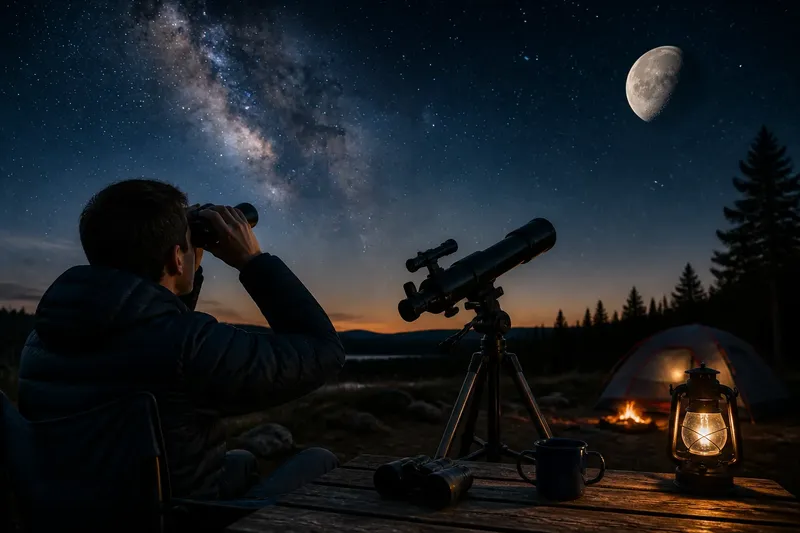
Binoculars or a small telescope comes down to the view you want: a broad sweep of stars or a closer look at a specific object. Binoculars show more surrounding sky at once; a telescope concentrates attention on the Moon and planets.
The difference is not simply magnification. It is closer to choosing between a map and a magnifying glass: one gives context, the other makes a smaller area easier to inspect. Field of view, mount, handling and target all shape which instrument will suit you.
Binoculars or a small telescope offer different kinds of view
Binoculars use two optical tubes, one for each eye, and usually show a broad patch of sky. That makes them useful for scanning star fields and seeing an object in relation to nearby stars. The Pleiades, for example, often make more sense as a cluster when their surrounding stars remain in view.
A telescope collects light through one optical tube and lets you change eyepieces. Higher magnification can make a target look larger, but the visible patch of sky narrows and tracking becomes more demanding. A telescope is therefore better suited to deliberate viewing than to sweeping across a constellation.
Broad star fields favour binoculars
Binoculars suit open clusters, bright nebulae and the Milky Way’s crowded fields, provided the sky and instrument make those targets visible. Their wide view can make it easier to move from a recognisable group of stars towards an object. They are also straightforward to carry and use without aligning a telescope finder.
Handheld views can wobble, particularly with heavier or more powerful binoculars. Bracing your elbows or using a stable support helps; a tripod adapter is another option for longer viewing. If you wear glasses, check whether the eyecups and eye relief let you see the full field comfortably.
Lunar and planetary detail favours a telescope
A small telescope can show the Moon’s craters and the changing shadows along its terminator, the boundary between lunar day and night. It can also reveal Jupiter’s bright moons and Saturn’s rings when the planets are well placed and conditions allow. These are modest views, not the large, polished images commonly used in books and online.
The mount is part of the instrument’s usefulness. An alt-azimuth mount moves up, down, left and right; smooth controls help keep an object in the eyepiece. A tabletop reflector needs a firm surface at a comfortable height, while a tripod should remain steady when touched. A shaky mount can make a promising telescope rather tedious.
Choose according to the view you want
- Observation: You want to see constellations and star clusters in context. If a broad field is the priority, choose binoculars; if close detail matters more, choose a telescope instead.
- Observation: Your main target is the Moon or a bright planet. If you want to inspect surface features or planetary companions, choose a telescope with a steady mount; if you mainly want a quick, wide view, binoculars are the simpler alternative.
- Observation: Your observing spot has a narrow opening between buildings or trees. If a bright target clears that opening and detail is your aim, use a telescope; if you need to scan a larger clear patch, binoculars offer the more suitable view.
- Observation: You need to carry the instrument between locations. If compact packing and quick use matter most, choose binoculars; if you accept carrying a tube and mount for a closer view, choose a telescope.
- Observation: You do not yet know which kind of viewing you prefer. If you can borrow both or attend an astronomy club session, compare their views before deciding; if neither option is available, choose by your intended target rather than by a magnification label.
- Observation: You wear glasses while observing. If a binocular model lets you see its full field comfortably, it remains an option; if the field is cut off, try another model or compare with a telescope eyepiece that suits your glasses.
Imagine you have an hour at a dark campsite, with the Pleiades, a stretch of the Milky Way and the Moon all visible. You want to locate the cluster, sweep the star fields and finish with a glance at the Moon. Binoculars fit that plan because their broad view keeps the cluster and surrounding stars together; if close lunar craters were the main aim instead, a small telescope and steady mount would be the better trade-off.
Field of view affects finding and tracking
Field of view means the amount of sky visible at once. Binoculars generally show a wider area than a telescope at high magnification, making it easier to see how a target sits among nearby stars. A telescope’s narrower view makes a small target more prominent, but the object can drift out of sight as Earth turns.
A telescope finder, either red-dot or optical, helps point the tube towards a target, but it needs to be aligned with the main view. Binoculars can make orientation simpler because familiar star patterns remain visible around the target. Neither instrument replaces knowing where to look; they simply offer different amounts of sky in the eyepiece.
What should you check before choosing?
Do binoculars need a tripod?
No, not always. Lighter binoculars can be held for brief views, while heavier or more powerful models are easier to use from a tripod or other stable support.
Can a small telescope show planets clearly?
It can show bright planets as discs and may reveal details such as Jupiter’s moons or Saturn’s rings when conditions permit. Expect a small view, and remember that atmospheric turbulence can blur the image.
Is higher magnification better?
Not by itself. Higher magnification narrows the field and makes aiming, tracking and atmospheric blur more noticeable, so a steadier lower-power view can be more useful.
What should I compare before buying?
Compare the view of your intended target, how the instrument is supported, and whether you can handle it comfortably at your observing spot. If possible, look through both types at an astronomy club event; a specification sheet cannot show how a particular view feels to you.
Handling and care shape the observing experience
Binoculars need little setup, but a steady position matters. A chair with armrests, a wall or a tripod can reduce movement. A telescope needs room for its mount, access to the eyepiece and space to avoid knocking the tube while you observe.
Clean lenses or mirrors only as the manufacturer advises; unsuitable materials can damage optical surfaces or coatings. For either instrument, a dim red light can help with reading a chart while preserving more dark adaptation than a bright screen. A paper chart has no battery to negotiate with, which is a modest but useful quality.
Which instrument suits your observing plans?
For a broad view of star fields and clusters, binoculars or a small telescope points towards binoculars. For closer lunar and planetary detail, a small telescope with a stable mount is the stronger fit. The right choice depends on the targets you want to frame, not on the largest magnification printed on a box.
Before deciding, name one target and the place you expect to observe it from. If your main interest is a cluster in context, binoculars are likely to give the more satisfying framing; if you want to examine lunar shadows, a telescope is better suited. Matching the instrument to that specific view makes the binoculars or small telescope decision far clearer.